
Custom machines
Custom machines for the manufacturing process that needs an upgrade
Loading, feeding, orienting, indexing, placing. When one of those is still done by hand and nothing in a catalog does it the way your line needs, we design and build the machine that does. We define it with you before anything is cut, build it in Omaha, prove it against acceptance criteria you approved, and ship it to you anywhere in the United States.
- Scope
- One focused process
- Schedule
- As little as 10 weeks
- Price
- Fixed quote before the build
- Before it ships
- We test it on your parts
The operation today
When one manual operation starts holding production back
A process does not have to be broken to hold production back. If any of these sound familiar, and the operation is stable enough to describe but too specific for catalog equipment, it may be ready for a machine.
The station will not stay staffed
Training takes time, turnover resets it, and the people you do have spend their shift on repetitive handling.
One manual operation limits the line
The equipment around it has capacity to spare, but loading, feeding or placing by hand cannot keep up.
Results change by operator or shift
Cycle time, placement and rework depend on who is running the job that day.
Overtime is covering a process problem
More hours keep orders moving, but they do not remove the constraint.
The work is hard on people
Repetitive, awkward or fatiguing motion that nobody wants to do for a full shift.
Catalog equipment almost fits
It does most of the job, but not with your parts, your fixtures or your floor space.
A focused machine takes the repetitive part of the job, and your people keep the work that needs their judgment.
One we built
How we built a machine to open bags all day
Walkthrough of a custom machine we built to open bags continuously. Built on the same T-slot compatible frame and SDLA belt-driven actuators we sell.
How we built a machine to open bags all day
The problem with most machine projects
The risk is in the details that get overlooked
A warped part. Two bags picked instead of one. The rework loop everybody works around. What the machine should do when the line upstream stops. These are the details that decide whether a machine is worth the electricity it runs on, and they are usually the ones nobody put in writing before the quote went out.
Then the price grows, the schedule moves, and your engineer spends their week relaying messages between a builder, maintenance and the operators who actually run the job.
The second risk arrives later. A machine nobody documented is a machine nobody can fix. Yours ships with the drawings, the bill of materials, the commented controls program and a manual written for the people who will maintain it. If something goes wrong after that, we're just a phone call away.
Why work with us
We can't compete on size. We compete on how your project is handled.
Large integrators are built for large programs. A single machine can end up as the small job in their queue: slow replies, a salesperson between you and the engineer, and a quote that changes once someone finally looks at your parts. A focused machine is the work we do, so it is never the small job here.
01
You work with the people building it
Your questions go to the people who design and build the machine, not to a salesperson who passes them along. Nothing gets lost in translation, and the answers come from someone who knows your machine.
02
We understand the application before we design anything
Your parts, your operators and the equipment on either side of the machine go on paper first. The details that sink machine projects get found while they are still cheap to fix.
03
You always know where it stands
A reply within two business days, dated milestones in the proposal, and a short written update every week of the build. If something changes, you hear it from us first.
04
The details are our job, not yours
A fixed quote with every assumption written down, acceptance criteria agreed before the build, and a test on your parts before the machine ships. Your engineer should not have to chase any of it.
Fit
Is your operation a fit?
A good fit
- • One primary operation, with one place an operator loads or unloads
- • Bag, pouch and part handling, feeding, indexing, orienting, pick and place, load and unload
- • A stable process, with representative parts you can send us
Not what we build
- • High-speed multi-station lines
- • Sterile, GMP or regulated validation packages
- • Food-contact sanitary construction
- • Hazardous-location ratings
- • Steps where an hour of downtime is a crisis for the plant
For those, a larger integrator is the right call and we will say so.
Define first
Define the machine before you fund it
The expensive outcome is a machine designed around a guess. Machine Definition is a short paid engagement on your parts and your process that removes the guesswork first. It ends with a recommendation and a proposal, or a straight recommendation not to build it.
We aim for a 12 to 24 month return on investment. If we don't think the machine can get there, we'll tell you before you spend anything on the build.
- • A one-page map of how the operation runs today
- • One recommended concept, and one we rejected with the reason why
- • What the machine has to work with: your operators, the fixtures, the equipment upstream and downstream, then air, power and network
- • The top technical risks, and what it would take to rule each one out
- • A preliminary layout
- • Measurable acceptance criteria for the factory test
- • A fixed-price proposal with a concept design, the assumptions behind it, and dated milestones
If a mechanism has not been proven on parts like yours, we test it on a sample before the price is locked. We would rather find out on a bench than in your plant.
How it works
- Starts with
- A free 15-minute scoping call
- Fee
- Fixed, quoted on the call
- You get
- A fixed-price proposal within five business days of kickoff and receipt of your parts
- Credit
- The full fee comes off the price of the machine it scoped, if you order it within six months
If the job is outside what we build, we will say so on the call, before you pay anything.
Schedule a 15-minute scoping callSchedule
Dated milestones, so you always know where your machine stands
Whether it is as little as 10 weeks or as long as six months, we scope the project up front and keep you updated on milestones along the way. Every proposal carries dates you can plan around. During the build you get a short written update every week: what was done, what is next, and anything we need from you. If a date moves, you hear why in writing that week.
01
Define
Your parts and your process: concept, interfaces, risks and acceptance criteria.
02
Propose
Within five business days of kickoff: a fixed price, a concept design, the assumptions behind it, and dated milestones.
03
Final design
After the first payment. We walk you through the design on a video review, and you approve it before anything is cut.
04
Build
Fabrication, assembly, wiring and programming in our Omaha shop, with a written update every week.
05
Prove it
Run-off on your parts, then a factory acceptance test against the criteria you approved.
Shipping, installation and site acceptance are scheduled separately. Carrier timing, site readiness, utilities and production access are yours, so they sit outside the shop-build dates.
Built around your line
Modular, so the next change is a modification and not a rebuild
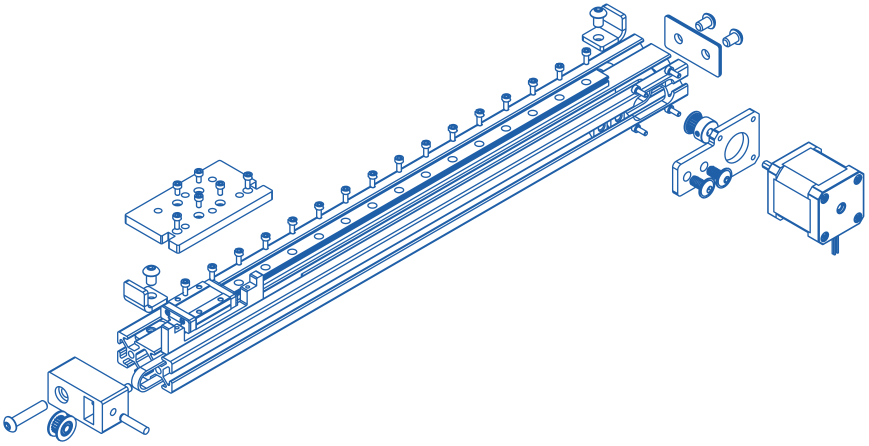
Frames are T-slot compatible extrusion and the axes are our own SDLA belt-driven actuators, so the machine is built from parts made to be added to and rearranged.
We size motors and drives to the application rather than defaulting to the most expensive option that would work, and the change points get designed in on purpose, which is what we take care of during Machine Definition.
Add-ons are easier
A new sensor, a guard or a second station mounts to the frame the machine already has.
Sourcing is simple
Standard means standard: a 12mm round sensor you can buy from any supplier, not a part number only we can source.
A change is not a rebuild
When your product or process changes, a longer stroke or a new fixture is a modification to a machine you already own. It still takes design time, machining and material, but you are not starting over.
Proof
Focused machines already running
Bag feeding and pick and place cells built on the same components we sell. Each one started as an operation that did not fit anything in a catalog.
How we built an automated bag feeder
An automated bag feeder, from design to build.
High-speed pick and place with SDLA actuators
The same actuators we sell as standalone axes, bolted to standard T-slot extrusion. No special versions, no proprietary controls.
Pick, rotate, and place in one move
Pick a part from one fixture, rotate it 180 degrees mid-transfer, and drop it into the next. Simple motion, repeated hundreds of times.
Handoff and support
You own the machine, and everything needed to keep it running
Your maintenance team should be able to troubleshoot the machine without us in the room. The file package is part of what you buy, brought current at the end of debug rather than promised and forgotten.
We work risk assessment into the design from the first scoping call through the factory acceptance test. If something goes wrong after installation, we help you fix it, whether that means tracking down the supplier for a wear part or modifying the design on a pin that keeps breaking. We get better by learning what goes wrong on the factory floor, so we want to hear from you. On-site startup and maintenance are available as a separate paid service.
- • Drawings and 3D models
- • BOM with spare parts called out, standard components wherever possible
- • Controls program source with comments, backups and passwords
- • Manual with fault recovery steps
- • Training for operators and maintenance at the acceptance test, recorded so you can replay it
Questions
What buyers ask before they hire a machine builder
- Which process should we automate first?
- Start with a repetitive operation you already understand that creates a constraint you can measure: staffing, cycle time, overtime, quality, rework or awkward handling. The first project should matter enough to be worth doing and be bounded enough to define. If several operations compete for attention, an Automation Roadmap ranks them before any machine is scoped.
- How do we know if a custom machine is worth it?
- Start with what the constraint costs you today: labor hours, overtime, lost output, scrap and rework, and inspection time. Count the whole investment on the other side, including installation, training and maintenance, not only the machine. We aim for a 12 to 24 month return on investment, and if we don't think a machine can get there, we'll tell you before you spend anything on the build.
- How much does a custom machine build cost?
- It depends on the operation, the parts and the rate, which is why we define the machine before anyone prices it. Machine Definition ends with a fixed-price proposal, with every assumption the price rests on written out. If the honest answer is a fixture, a single axis or an actuator with controls rather than a machine, we will tell you that instead.
- How long does it take to design and build a custom machine?
- As little as 10 weeks, or up to six months, depending on scope. Every proposal carries dated milestones, and you get a written update every week during the build. Shipping, installation and site acceptance are scheduled separately because they depend on your site.
- Does our process need to be perfectly consistent?
- No, but its variation has to be something we can see and put limits on. We need representative good parts, the problem parts, your changeovers, and the exceptions operators handle today. If an unknown could change the concept or the price, we test it on a sample before the price is locked.
- How much of our team's time will it take?
- We need access to the people who know the operation, representative parts, information on the fixtures and equipment around it, your target rate and quality, and timely decisions at each review. Before fabrication, everything you supply is listed with an owner. During the build, the weekly update says what we need from you next.
- What is included in the price, and what is not?
- The fixed price covers the final design, fabrication, assembly, wiring, programming, debug, the run-off on your parts, the factory acceptance test and the documentation package. Every assumption the price rests on is listed in the proposal. If the price depends on something nobody has measured yet, the proposal says so and carries a contingency for it, billed only if the trigger occurs and only with your written approval. Priced separately in writing: site installation, on-site startup, travel, scope changes you request, production materials, freight, taxes, and work outside the interfaces listed in the definition.
- Can the machine fit into our existing line?
- That is the normal case. Machine Definition produces the list of everything the machine has to work with: your operators, the fixtures, the equipment upstream and downstream, and the air, power and network it needs. Each one has an owner before fabrication starts, so nothing surprises anybody at startup.
- Should we build it ourselves, buy a cobot, or hire a larger integrator?
- Build it yourselves if you have the team, the tools to design and build it, and the machine design and controls expertise in house, with the time to spend on it. If any of those is missing, the machine competes with everything else those people are responsible for. Repeat builds get cheaper either way, including when we build them, because the design, the program and the parts list carry over. A cobot makes sense when flexible six-axis motion or frequent redeployment matters, but a cobot is only the arm: it still needs tooling, fixtures, controls and integration before it does any work. Choose a larger integrator when complexity, regulated validation or the cost of downtime calls for parallel teams and field service. Choose us for a focused operation where working directly with the people building it, and a schedule you can see, matter most.
Start
A sketch, a photo or a paragraph is enough
Tell us what the operation is, what it runs on, and how fast it needs to go. If you have them, these help most: a link to a short phone video of the job being done, a few parts including the problem ones, and what changes between products. You will hear back within two business days from the people who would build it, with a straight answer on whether it is a fit for us.
Schedule a 15-minute scoping call
Based in Omaha. We build in our shop and ship anywhere in the United States.